

Mandi bhav (मंडी भाव) is the daily wholesale price a crop fetches at a government-regulated APMC mandi — discovered through open auction between farmers, traders, and commission agents each morning. The Government of India publishes these rates for free, every day, on Agmarknet (agmarknet.gov.in) and eNAM (enam.gov.in), covering thousands of mandis across every state. The number moves with three things — which mandi you're asking about, the grade of the crop, and how much arrived that day — so "today's mandi bhav" is never a single all-India figure; it's a range read mandi by mandi.
This guide covers how to check mandi bhav today for onion (pyaj) and potato (aalu) — the two crops Indian buyers search for most — the government sources that publish rates for free, and how to read those numbers before deciding when to sell. It does not quote today's price for any crop: auction prices change mandi to mandi and day to day, and a number printed here would be stale before this page finishes loading. What it gives instead is the method — where to look, what the numbers mean, and how Madhya Pradesh's mandis specifically behave.
What "Mandi Bhav" Means and Who Sets It
India's wholesale agricultural trade runs through APMCs — Agricultural Produce Market Committees — state-regulated market yards where licensed traders and commission agents bid on a farmer's produce lot by lot, in the open, in front of the farmer. That's different from a farmer accepting whatever a local trader offers at the farm gate: at a mandi, multiple buyers compete for the same lot, and the price is set by that competition, not by one buyer's opinion of what the crop is worth.
Every mandi publishes three numbers for each crop each day: the minimum price, the maximum price, and the modal price — the price at which the largest volume of that crop actually changed hands. The modal price is the number farmers and traders mean when they say "mandi bhav" — the most representative figure, not the highest or the most optimistic one.
The single biggest driver of that modal price, day to day, is arrivals (आवक) — the quantity of the crop that reached the mandi that morning. Heavy arrivals push the modal price down even if demand hasn't changed, because more lots are competing for the same buyers. Thin arrivals — after a break in harvest, a transport disruption, or a festival lull — push it up. A farmer checking mandi bhav should always check the arrival figure alongside the price; a price without an arrivals number tells only half the story.
Where to Check Mandi Bhav Today (Free Official Sources)
Four free sources cover almost every mandi bhav lookup an Indian farmer or buyer needs, and none of them require a login. Agmarknet (agmarknet.gov.in), run by the Ministry of Agriculture & Farmers Welfare's Directorate of Marketing and Inspection, is the oldest and most complete: daily min/max/modal price and arrival data for thousands of mandis, searchable by state, district, mandi, and crop. eNAM (enam.gov.in) — the National Agriculture Market — is the government's e-trading platform, and it publishes trade data for the mandis integrated into it, including per-lot prices, not just the daily summary; where a mandi is on eNAM, its data updates faster and in more granular detail than Agmarknet's daily digest.
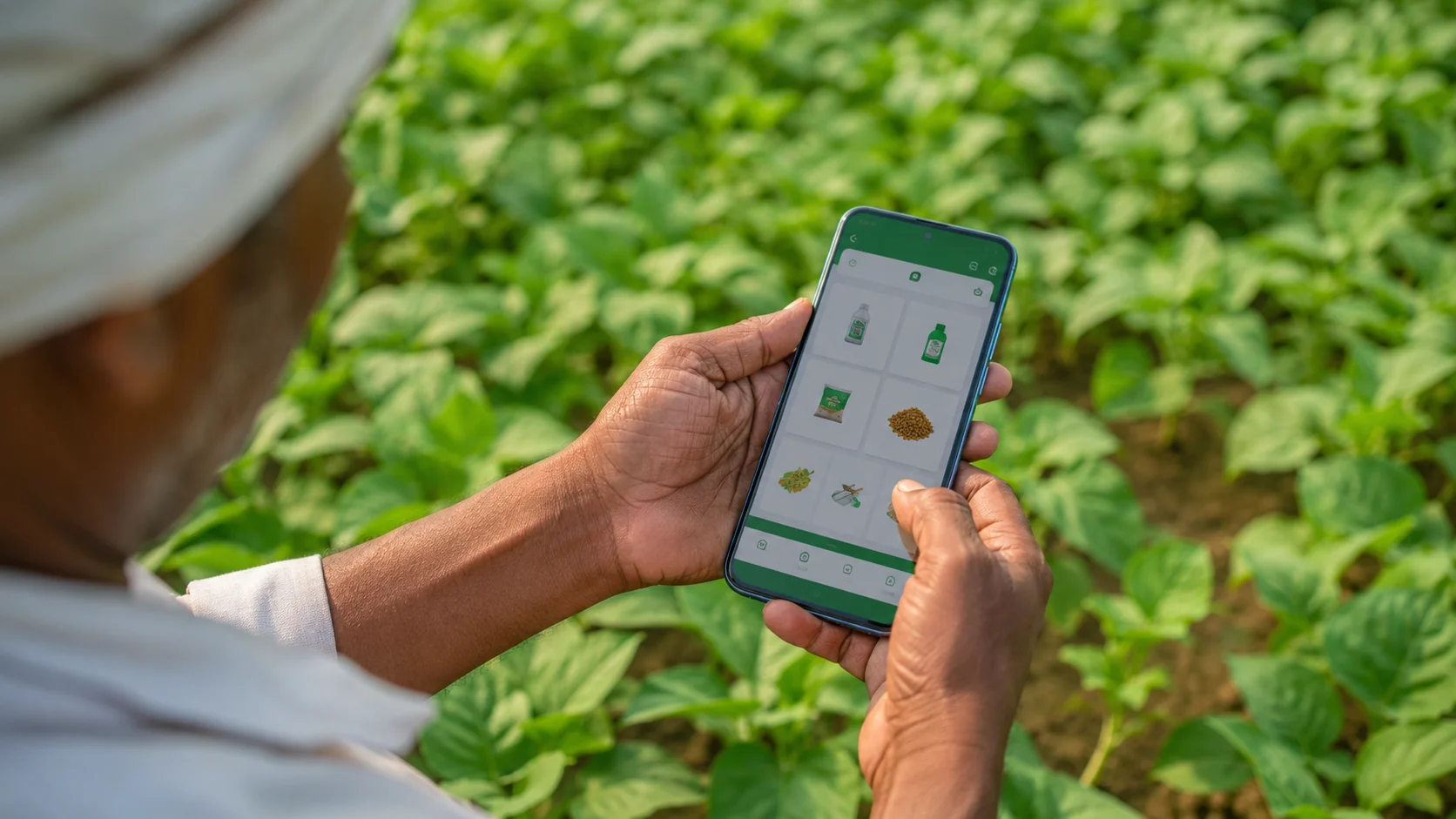
State agriculture marketing boards, Madhya Pradesh's Mandi Board among them, run their own portals with state-specific views, and often publish MSP and procurement-centre information alongside open-market rates — useful for telling the two apart (see the FAQ on MSP vs mandi bhav below). Kisan Suvidha, the Government of India's farmer app, pulls mandi price data into a mobile-friendly format alongside weather, advisories, and input dealer locators — the practical choice for a farmer checking prices from a field rather than a desktop browser.
| Source | Coverage | Update timing | Format |
|---|---|---|---|
| Agmarknet | Thousands of mandis, all states | Daily, published evening | Web, downloadable data |
| eNAM | eNAM-integrated mandis | Near real-time, trade by trade | Web, mobile app |
| State Mandi Board portals | State-specific mandis | Daily | Web |
| Kisan Suvidha app | National, mandi-level | Daily | Mobile app |
Pyaj Ka Bhav (Onion Prices): Why They Swing So Much
Pyaj ka bhav (प्याज का भाव) — onion prices — swings harder than almost any other vegetable in the Indian mandi system, and the reason is structural, not random. Onion has multiple overlapping crop seasons a year, but only the rabi crop stores well, so India runs on stored rabi onion for months until the next harvest arrives. Whatever affects that stored stock — humidity damage, a delayed monsoon extending the storage window, or farmers holding back supply for a better rate — shows up directly in the modal price.
Lasalgaon, in Maharashtra's Nashik district, is Asia's benchmark onion mandi and the market the rest of the country watches: when Lasalgaon's modal price moves, mandis across India tend to move with it within days, because Lasalgaon-area stock and pricing signal what the national stored-onion supply looks like.
Madhya Pradesh runs its own significant onion trade, concentrated in Indore, Ujjain, and Mandsaur mandis — real rabi onion acreage with arrival patterns that can diverge from Lasalgaon's for weeks depending on local storage losses and district-level demand. A trader or farmer in MP checking pyaj ka bhav should track both: Lasalgaon for the national direction, and the nearest MP mandi's own arrivals and modal price for what will actually be paid.
Monsoon timing compounds all of this. A late or heavy monsoon delays kharif onion arrivals, extends dependence on ageing rabi stock, and tends to push prices up through the gap; an early, well-spread monsoon does the reverse. None of this is a fixed calendar — it is read fresh each season from arrivals data, not assumed from last year's pattern.
Aalu Rate Today (Potato Prices): Reading the Cold-Storage Cycle
Aalu rate (आलू का भाव) — potato prices — follows a cycle that is more predictable than onion's, because potato production in India concentrates heavily in Uttar Pradesh and West Bengal, with Punjab, Bihar, and Gujarat contributing meaningfully as well.
The crop is harvested once a year, in February–March, and that harvest window sets the low point of the annual price cycle: fresh arrivals flood mandis simultaneously across UP and West Bengal, arrival volumes peak, and modal prices bottom out — this is when potato is cheapest and cold storages fill up for the rest of the year.
From April onward, fresh-market potato is gone and the country runs on cold-storage stock. Storage owners and farmers who put potato into cold storage after harvest release it gradually through the year, and prices climb as storage-release month follows storage-release month — the climb usually sharpens through August–October, as remaining stock thins and the next fresh crop is still months away. Storage rent, financing cost on stored stock, and expected shortfall before the next harvest all get priced into what a cold-storage release fetches at the mandi.
Reading aalu rate today means knowing which half of this cycle you're in — check the month before checking the price. A mandi bhav figure in March means something different from the same rupee number in September, because one reflects fresh-harvest abundance and the other reflects the cost of months of storage.
Madhya Pradesh Mandi Rates: The Mandis That Matter
Madhya Pradesh runs some of the busiest agricultural mandis in central India, and five in particular carry weight beyond their own district: Indore and Ujjain for onion, soybean, and wheat volumes; Bhopal, the state capital, with steady institutional demand; and Khargone and Barwani for the cotton and banana belt in the state's south-west. A farmer selling from anywhere in the Nimar region typically checks at least two of these five before deciding where to truck a harvest, because the transport cost difference between mandis often matters as much as the price gap itself.
Arrivals at MP mandis follow the state's cropping calendar closely: soybean and cotton dominate kharif-season arrivals, wheat and gram dominate rabi-season arrivals, and onion arrivals run in windows tied to the rabi and late-kharif onion crop. Checking Agmarknet or eNAM filtered to the specific MP mandi — not a statewide average — is the only way to get a number that reflects what a specific harvest will actually fetch.
Timing a sale around mandi bhav only pays off if the crop reaches the mandi in sellable condition, and that increasingly depends on irrigation reliability through the growing season — a farmer who can water a crop on schedule through a dry spell controls harvest timing, and harvest timing is what determines whether a crop arrives during a price trough or a price peak. R-Solar's solar water pump installations across Madhya Pradesh exist for exactly this reason: irrigation control is upstream of every mandi-bhav decision a farmer makes downstream. The same logic applies to input cost — Farmkart's input procurement platform lets a farmer lock in seed, fertiliser, and crop-protection costs before sowing, so the mandi bhav a harvest eventually fetches isn't eaten up by inflated local input pricing.
How Farmers Use Mandi Data to Time Sales
Checking mandi bhav once, on the day you plan to sell, tells you today's number. Checking it as a trend — the modal price for the same mandi and crop over the preceding one to two weeks — tells you whether that number is rising, falling, or flat, and that trend is what actually informs a sell-or-hold decision. A single day's modal price can be distorted by one unusually large or small arrival; a trend line filters that noise out.
Arrival volume is the leading signal, not the price itself. Rising arrivals with a flattening modal price usually means the market is close to absorbing peak supply — prices are likely to soften from here. Falling arrivals with a firming modal price usually means supply is thinning ahead of demand — a signal that holding a few more days, where storage allows, can pay off. Farmers who only watch the price and ignore the arrivals column are reading half the data.
This is the same shift in thinking that separates a farmer who sells at whatever price is offered from an agripreneur who treats the harvest as an asset to be sold on favourable terms, not a perishable liability to be offloaded immediately. Reading mandi bhav trend data before deciding when and where to sell is a small habit with an outsized effect on realised price — the gap between a modal price on a glut day and the same crop's modal price at the same mandi ten days later is routinely wide enough to change a season's ROI.
Frequently Asked Questions
Aaj ka mandi bhav kaise dekhen? (How do I check today's mandi rates?)
Open Agmarknet (agmarknet.gov.in), select your state, district, mandi, and crop, and the site shows that day's minimum, maximum, and modal price along with arrivals. eNAM (enam.gov.in) covers the same data for eNAM-integrated mandis, often updated faster. The Kisan Suvidha app gives the same lookup on mobile.
What time are mandi prices updated each day?
Arrivals and auctions at most APMC mandis close by early afternoon. Agmarknet compiles and publishes that day's minimum, maximum, and modal price the same evening, so checking after evening gives the finalised number rather than an in-progress one. eNAM-integrated mandis update closer to real time as trades are recorded through the day.
Why is pyaj ka bhav different in every mandi?
Each mandi's modal price reflects its own arrivals that day, the grade mix of onion reaching it, transport cost from the nearest growing belt, and local demand from traders sourcing for that region. Two mandis a short distance apart can post modal prices that differ meaningfully on the same day for exactly these reasons.
Is mandi bhav the same as MSP?
No. MSP (Minimum Support Price) is a government-announced floor price for notified crops, used when government agencies procure directly from farmers — it doesn't move day to day. Mandi bhav is the open-auction price discovered daily at APMC mandis between private traders and farmers, and it can be higher or lower than MSP depending on market conditions.
Which app shows mandi bhav for Madhya Pradesh?
Kisan Suvidha and the eNAM app both show mandi bhav filtered to Madhya Pradesh mandis, crop by crop. For input prices — seed, fertiliser, crop protection — alongside that market data, the Farmkart app covers procurement so a farmer can compare selling price and input cost in one place.