

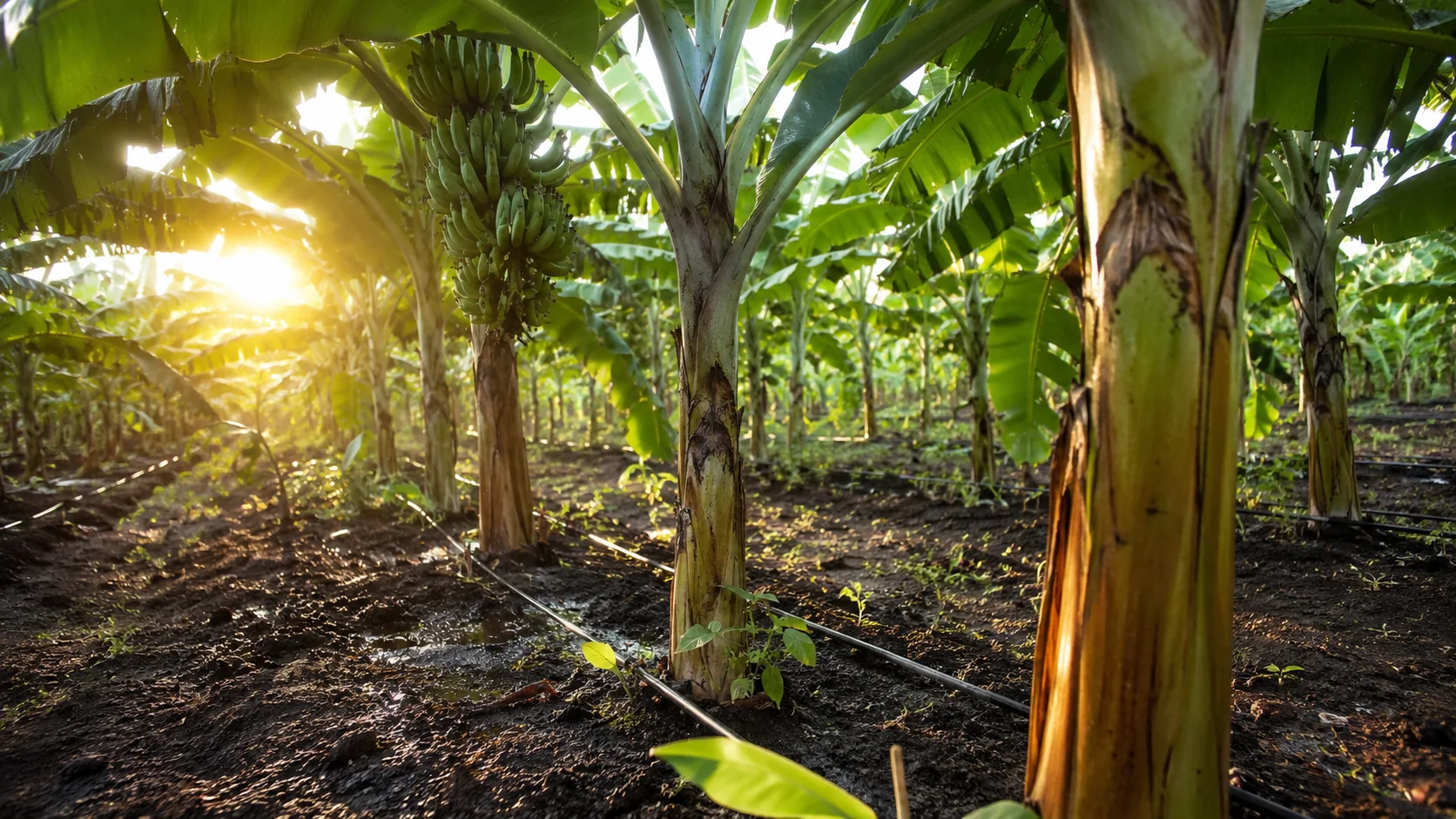
The standard banana fertigation schedule in India applies nitrogen, phosphorus and potassium at a 3:1:6 ratio through a drip irrigation system across 6–8 splits during the 11–14 month growing cycle. The total dose is approximately 200 g N, 35 g P, and 300 g K per plant — giving a 25–30% yield increase and 45% water saving compared to conventional flood irrigation with broadcasting. Farmers who power their drip systems with solar energy eliminate the electricity cost entirely — see R-Solar's solar irrigation pump guide for sizing and subsidy details.
This guide gives you the complete month-by-month schedule, the right products to use, special considerations for tissue culture (TC) bananas, and the common fertigation mistakes that quietly cost Indian farmers 15–20% of their yield. Sound familiar? Read on.
What Is Banana Fertigation?
Fertigation is the application of soluble fertilizers directly through a drip irrigation system. Instead of broadcasting granular fertilizer on the soil surface — where up to 40% of applied nutrients are lost to leaching, volatilisation or runoff — fertigation delivers nutrients directly to the root zone in dissolved form, at precisely the time the plant needs them.
For banana, fertigation through drip irrigation is particularly effective because bananas are shallow-rooted (80% of roots in the top 30 cm), have a high potassium demand throughout the growing season, and respond strongly to nitrogen during vegetative development and bunch filling.
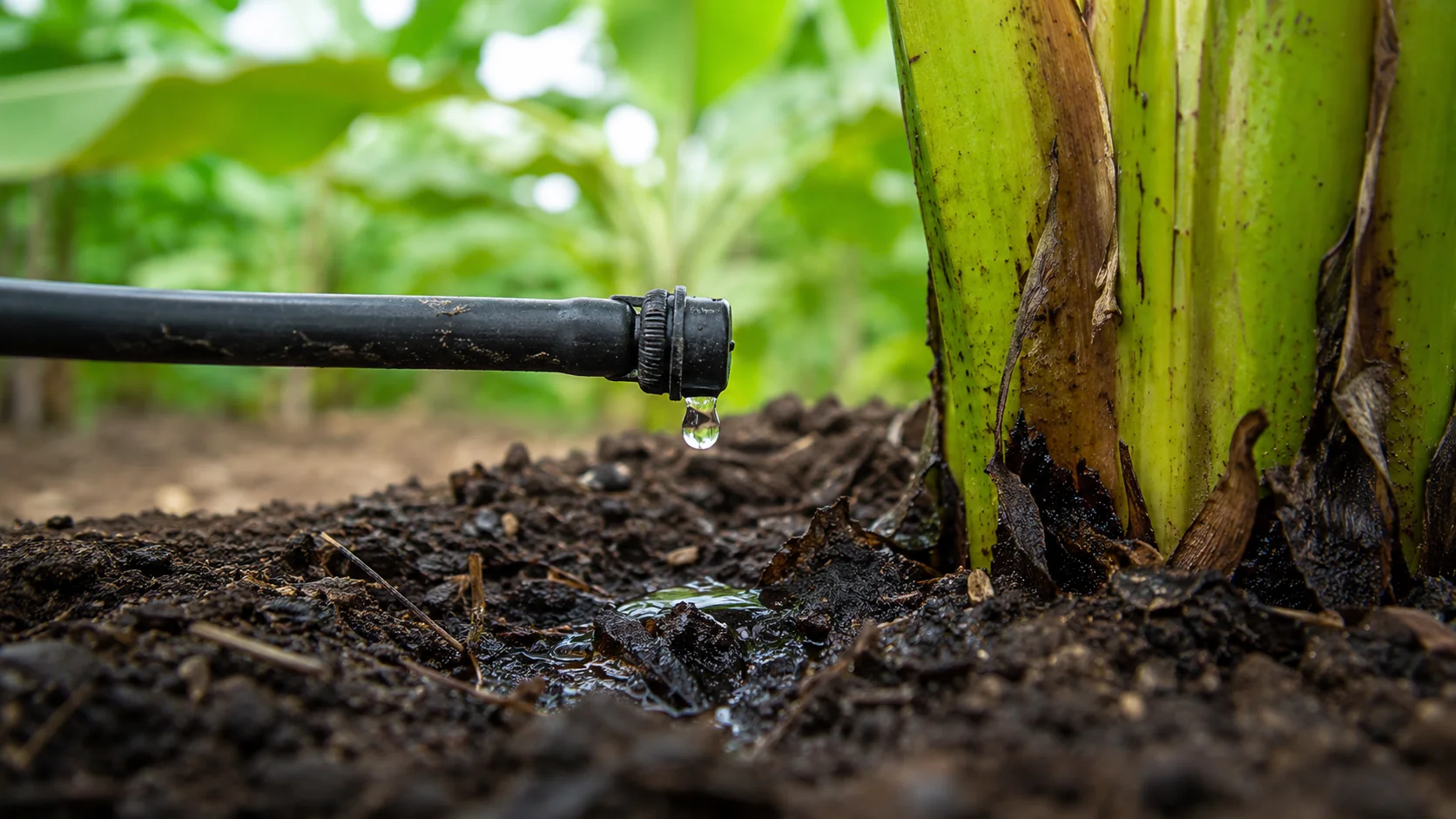
Why Drip Fertigation Outperforms Conventional Methods
The evidence across banana-growing states — Maharashtra, Tamil Nadu, Karnataka, Andhra Pradesh and Madhya Pradesh — is consistent:
- Yield increase: 24–46% higher yield vs. flood irrigation + surface broadcasting
- Water saving: 45.3% less water compared to flood irrigation
- Fertilizer use efficiency: 30–35% less fertilizer needed to achieve the same yield
- Uniformity: More uniform plant size and bunch weight within a plot
- Labour reduction: No manual fertilizer spreading; nutrients applied automatically with irrigation cycle
We recommend drip fertigation as the default approach for any banana farmer with more than 1 acre under cultivation. The payback period on a drip system in an average banana plot is 2–3 crop cycles when fertilizer savings and yield premiums are both counted.
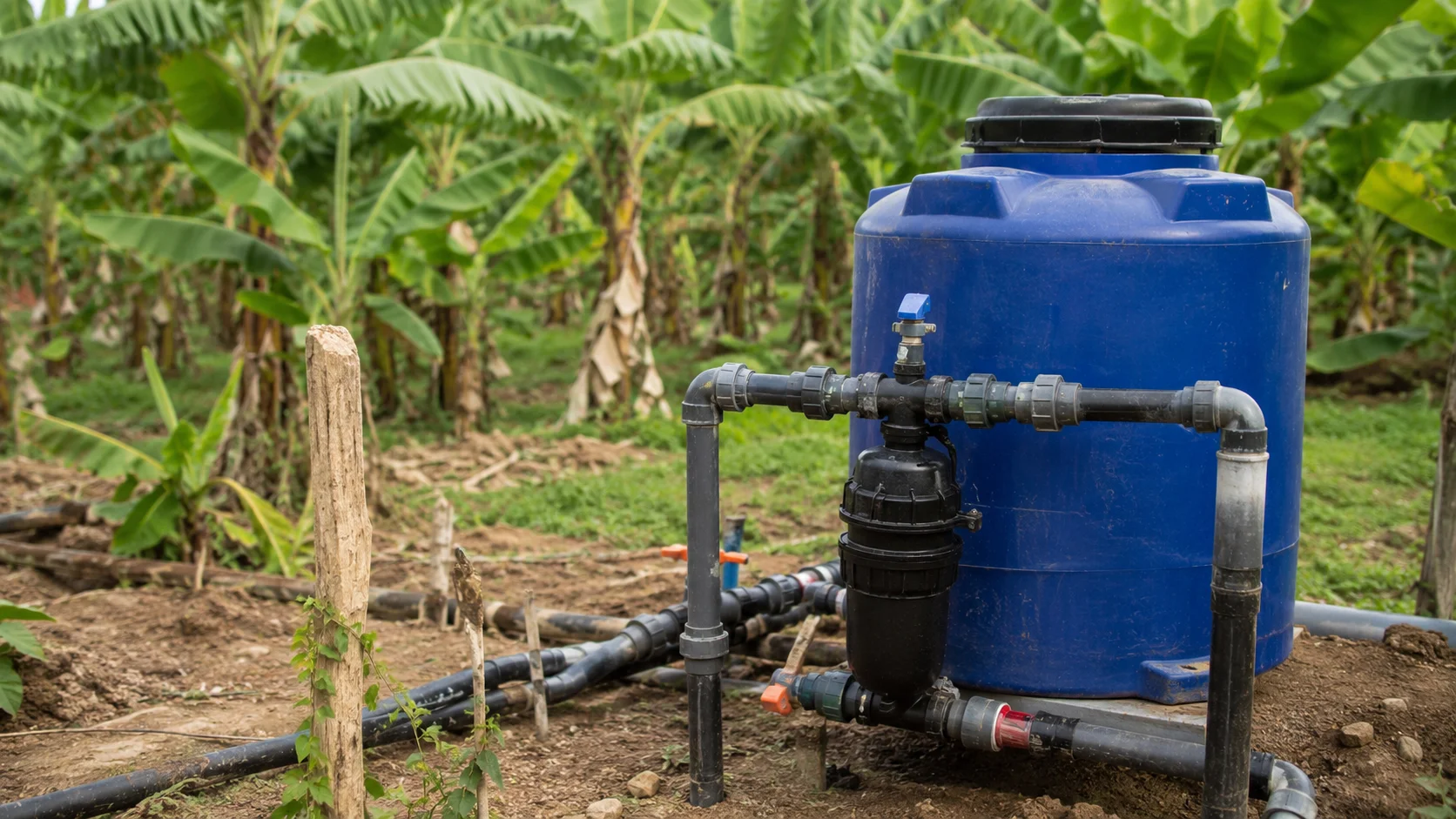
Nutrient Requirements: What Bananas Actually Need
Banana is a potassium-hungry crop — the K demand is roughly double the nitrogen demand. The full-season nutrient profile for Grand Naine (the dominant TC variety in India) at standard planting density (3175 plants/ha at 1.5 × 2.1 m) is:
| Nutrient | Per Plant (g) | Per Hectare (kg) | Primary function |
|---|---|---|---|
| Nitrogen (N) | 200 g | 635 kg | Vegetative growth, leaf area |
| Phosphorus (P₂O₅) | 35 g | 111 kg | Root development, energy transfer |
| Potassium (K₂O) | 300 g | 953 kg | Bunch weight, fruit filling, disease resistance |
Micronutrients matter too — particularly Magnesium (Mg) on acid soils, Zinc (Zn) for shoot development, and Boron (B) for bunch setting. If your bananas show interveinal chlorosis (yellowing between leaf veins), Mg deficiency is the first suspect.
Month-by-Month Banana Fertigation Schedule
This schedule is for Grand Naine tissue culture bananas under drip fertigation. Phosphorus is applied as basal at month 2; nitrogen and potassium are split across the drip system.
| Month | Growth Stage | N (g/plant) | P₂O₅ (g/plant) | K₂O (g/plant) | Notes |
|---|---|---|---|---|---|
| Month 0–1 | Establishment | 10 | — | 15 | Light fertigation only; roots not yet established |
| Month 2 | Early vegetative | 20 | 35 (basal) | 25 | Apply full P dose as soil basal (MAP/DAP); begin N+K through drip |
| Month 3–4 | Rapid vegetative growth | 40 | — | 50 | Highest N demand; split into 2 applications per month |
| Month 5–6 | Pre-flowering | 40 | — | 60 | Shift ratio toward K to promote bunch initiation |
| Month 7 | Flowering / bunch emergence | 30 | — | 50 | Reduce N slightly; maintain high K for fruit set |
| Month 8–9 | Bunch filling | 30 | — | 60 | K critical for fruit weight and shelf life; SOP preferred over MOP |
| Month 10–11 | Maturation | 20 | — | 30 | Taper off. Stop fertigation 15 days before harvest |
| Total | Full season | ~190–200 g | 35 g (basal) | ~290–300 g | Matches recommended full-season NPK dose |
Drip Irrigation Water Schedule
Water scheduling is as important as fertilizer scheduling. Under-irrigation stresses the plant; over-irrigation leaches nutrients and promotes root diseases.
| Growth Stage | Water per plant per day |
|---|---|
| Month 0–4 (establishment to early vegetative) | 5–10 litres |
| Month 5 to flowering (rapid vegetative to pre-flowering) | 10–15 litres |
| Flowering through bunch filling | 15 litres |
| 15 days before harvest | Taper to 5–8 litres (reduces splitting) |
A solar-powered submersible pump is the standard choice for drip-irrigated banana farms in MP and Maharashtra — it eliminates both the electricity bill and the diesel dependency.
Fertigation for Tissue Culture (TC) Banana Plants
Reva Flora, Farmkart Group's tissue culture division, supplies certified Grand Naine and G9 TC banana plants for use with the fertigation schedule below.
Tissue culture bananas — particularly Grand Naine G9 and Williams varieties sourced from certified laboratories like Reva Flora — establish faster and more uniformly than sucker-propagated plants. This changes the fertigation schedule in a few important ways:
- Earlier start: Begin fertigation at week 3 after transplanting (vs. month 2 for suckers). TC roots are sterile and well-developed; they uptake nutrients faster from the start.
- Higher early K demand: TC bananas develop a larger pseudostem more quickly and benefit from 20% higher K dose during months 4–7 compared to standard schedules.
- Gradual ramp-up: Start at 10–15% of the full dose in weeks 3–6, increasing to full dose by month 2. Sudden full-dose fertigation on young TC plants can cause salt stress.
In our experience with Reva Flora tissue culture banana farmers in Madhya Pradesh, TC plants following this ramp-up schedule consistently reach first hand emergence 3–4 weeks earlier than sucker-planted plots at the same field, with an average bunch weight 18–22% higher at harvest. The difference is most pronounced on laterite and black cotton soils common in central India.
Fertilizer Products to Use for Banana Fertigation
Water-soluble grade fertilizers are essential — do not use regular granular fertilizer in drip systems, as undissolved particles clog emitters. Common products used in India:
- For nitrogen: Urea (46% N, readily water-soluble); Ammonium Sulphate (21% N + 24% S, good for alkaline soils); Calcium Nitrate (for calcium-deficient soils)
- For phosphorus (basal): DAP solution; Mono Ammonium Phosphate (MAP 12:61:0) as soil application at month 2
- For potassium: MOP — Muriate of Potash (0:0:60) is cost-effective; SOP — Sulphate of Potash (0:0:50) preferred during bunch filling for chloride-sensitive varieties
- Multi-nutrient combinations: 19:19:19 NPK during early growth; 12:61:0 + 13:0:45 split during vegetative and filling phases
No-Brands supplies water-soluble agricultural inputs at distributor and retailer pricing — without the premium markup of branded products. The chemistry is identical; the savings go back to your farm.
Common Banana Fertigation Mistakes (and How to Avoid Them)
These are the fertigation errors we see most often on banana farms — each one quietly costs yield:
- Applying fertilizer when drip lines are dry: Always run plain water for 10 minutes before starting fertigation and 15–20 minutes after. This flushes fertilizer into the root zone and prevents salt burn at emitter points.
- Not adjusting for irrigation water quality: Hard water (>500 ppm TDS) with high bicarbonates can precipitate calcium and phosphate in lines. Test your water and use acidifiers if pH > 7.5.
- Skipping the late-season K dose: Many farmers stop heavy fertigation after bunch emergence. This is exactly when K demand peaks for fruit filling. Don't taper K before month 9.
- Using MOP (Muriate of Potash) during bunch filling: The chloride in MOP affects fruit taste and skin quality in chloride-sensitive varieties. Switch to SOP from month 7 onward.
- Not accounting for monsoon leaching: Heavy rain events flush potassium downward. After 3+ days of continuous rain, run a supplemental K fertigation cycle as soon as the drip system can operate.
Organic and Bio-Input Options for Banana Fertigation
For farmers pursuing organic certification or wanting to reduce synthetic fertilizer input costs, liquid bio-inputs can be applied through drip systems — with precautions:
- Use a minimum 100-mesh filter on all bio-inputs to prevent clogging
- Panchagavya (3%) and Jeevamrit (10%) work well as monthly drip treatments during months 3–7
- FYM and vermicompost (10–15 kg per plant at planting, plus top-dress at month 4) cannot be applied through drip — apply to soil around the plant
- Trichoderma-based biostimulants as drip soil drench at months 1 and 4 reduce Fusarium wilt incidence, which is the biggest disease risk for TC bananas in warm, humid conditions
Frequently Asked Questions
What is the N:P:K ratio for banana fertigation?
The recommended N:P:K ratio for banana drip fertigation is 3:1:6 using water-soluble fertilizers. Total dose: ~200 g N, 35 g P, 300 g K per plant over the full season. Phosphorus is applied as basal in month 2; N and K are split across 6–8 drip cycles.
How often should I fertigate banana plants?
6–8 times per year on low-fertility soils. On good black cotton or alluvial soils, 4–6 splits are sufficient. Weekly drip irrigation (without fertilizer every time) is standard — fertigation cycles are inserted every 2–3 weeks during peak growth.
Does drip fertigation actually increase banana yield?
Yes — drip fertigation delivers a 24–46% yield increase vs. flood irrigation + broadcasting, with 45% water saving. On sandy and calcareous soils where flood irrigation loses most applied nutrients to leaching, the difference is even larger.
Is the fertigation schedule different for tissue culture bananas?
Yes. TC banana plants can begin fertigation at week 3 (vs. month 2 for suckers), need a gradual 6-week ramp-up, and have a 20% higher K demand during months 4–7. Reva Flora recommends starting at 10–15% of full dose and scaling up progressively.
Which fertilizers are used in banana drip fertigation?
Urea or Ammonium Sulphate for N; MAP soil-applied for P; MOP (early) and SOP (bunch filling) for K; Calcium Nitrate on sandy/acid soils; Magnesium Sulphate on Mg-deficient land. Use only water-soluble grade products through the drip line.
Can I use organic fertilizers through drip fertigation?
Liquid bio-inputs (panchagavya, jeevamrit) can be applied through drip with a 100-mesh filter. Solid organics (FYM, vermicompost) are applied to soil only. Trichoderma drench through drip at months 1 and 4 is recommended for TC banana Fusarium wilt prevention.
Related Farmkart Group Resources
Farmers who treat banana cultivation as a business — tracking N:P:K costs, yield per hectare, and market timing — are practising agripreneurship in its most literal form.
If you're growing bananas for commercial scale, explore how Farmkart Group's companies support the full value chain:
- Reva Flora — certified tissue culture Grand Naine banana plantlets, disease-free, from our Madhya Pradesh biotech facility
- No-Brands — water-soluble fertilizers, crop nutrition products and crop protection inputs at distributor pricing
- Farmkart — digital agri marketplace for inputs ordering, agronomy advice and market linkage for banana farmers